 Image 1 of 2
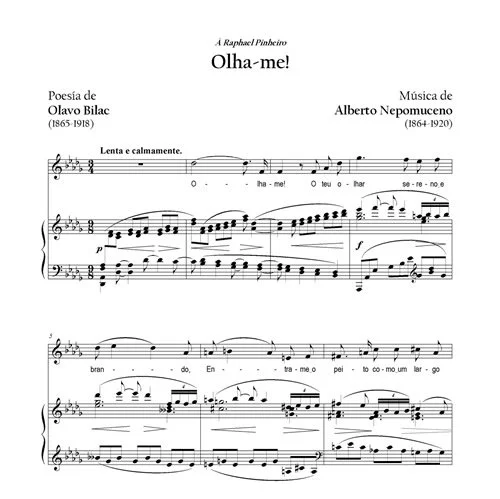 Image 2 of 2
Olha-me! (Look at Me!), composed in Rio de Janeiro in 1913, is a Brazilian art song for voice and piano by Alberto Nepomuceno (1864–1920), a pioneer of Brazilian musical nationalism and Portuguese-language vocal music. The text is a sonnet by Olavo Bilac (1865–1918), one of the leading representatives of Brazilian Parnassian poetry, known for his formal precision, sensual imagery, and expressive lyricism.
The poem explores the transformative power of love and desire through the beloved's gaze and voice. Images of flowing rivers, golden light, summer nights, stars, and fire convey the contrast between emotional solitude and passionate intimacy.
Marked Lenta e calmamente, the composition features a lyrical vocal melody supported by chromatic harmonies and flowing piano figurations. The simultaneous use of 3/4 in the voice and 9/8 in the piano creates rhythmic flexibility. Contrasting sections marked Un poco animato and Poco più mosso intensify the expression before a quiet piano postlude.
Listen to a recording: Olha-me! — Alberto Nepomuceno, Canções I, track 23 — Selo Minas de Som, Federal University of Minas Gerais.