 Image 1 of 2
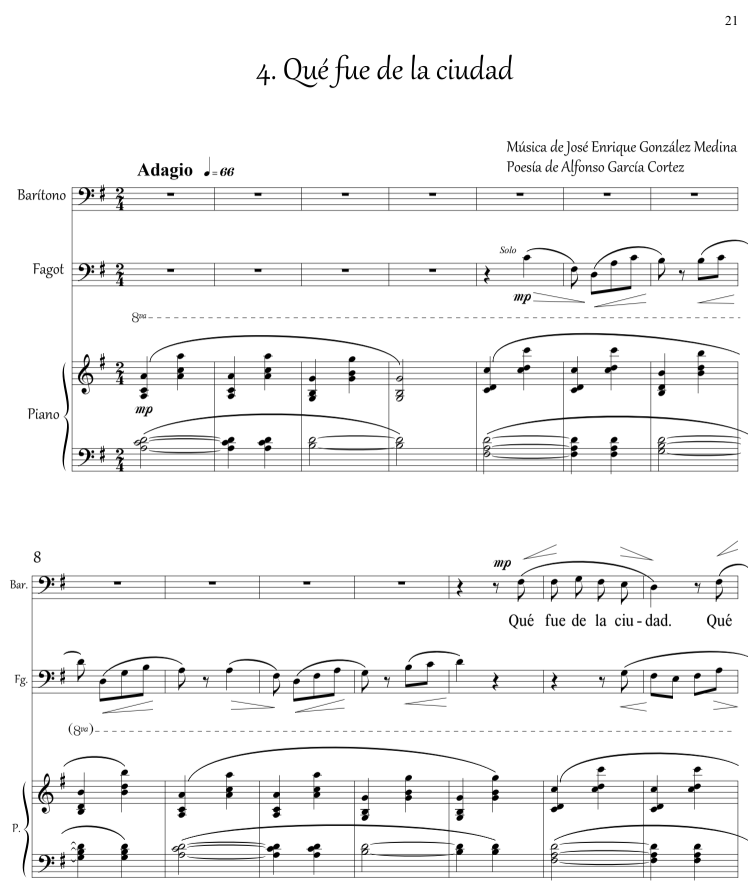 Image 2 of 2
Qué fue de la ciudad is the fourth song of José Enrique González Medina's Cinco canciones tijuanenses, with poetry by Alfonso García Cortez, presented in its chamber version for baritone, bassoon, and piano. The work is marked Adagio, unfolding as a reflective meditation on memory, identity, and the traces left by a changing city.
The poem opens with the haunting question, "¿Qué fue de la ciudad?" ("What became of the city?"), searching for the hidden places where the memories of childhood and collective history have disappeared. Through evocative images, the poet reflects on forgotten streets, lost footsteps, and the erosion of memory, while suggesting that the city continues to exist only in fragments of remembrance. The final return of the opening question leaves the listener suspended in quiet contemplation rather than resolution.
González Medina responds with a lyrical and atmospheric musical language in which the bassoon assumes a central expressive role, introducing and recalling the principal motifs throughout the work. The piano creates a spacious harmonic landscape that supports the voice while intensifying the emotional arc. The dialogue among the three performers gives the song the intimacy of chamber music while conveying the emotional depth of a dramatic monologue.
Instrumentation: Baritone, Bassoon, and Piano
Voice Type: Baritone
Language: Spanish
Composer: José Enrique González Medina (Mexico)
Poet: Alfonso García Cortez (Mexico)
Collection: Cinco canciones tijuanenses
Qué fue de la ciudad is the fourth song of José Enrique González Medina's Cinco canciones tijuanenses, with poetry by Alfonso García Cortez, presented in its chamber version for baritone, bassoon, and piano. The work is marked Adagio, unfolding as a reflective meditation on memory, identity, and the traces left by a changing city.
The poem opens with the haunting question, "¿Qué fue de la ciudad?" ("What became of the city?"), searching for the hidden places where the memories of childhood and collective history have disappeared. Through evocative images, the poet reflects on forgotten streets, lost footsteps, and the erosion of memory, while suggesting that the city continues to exist only in fragments of remembrance. The final return of the opening question leaves the listener suspended in quiet contemplation rather than resolution.
González Medina responds with a lyrical and atmospheric musical language in which the bassoon assumes a central expressive role, introducing and recalling the principal motifs throughout the work. The piano creates a spacious harmonic landscape that supports the voice while intensifying the emotional arc. The dialogue among the three performers gives the song the intimacy of chamber music while conveying the emotional depth of a dramatic monologue.
Instrumentation: Baritone, Bassoon, and Piano
Voice Type: Baritone
Language: Spanish
Composer: José Enrique González Medina (Mexico)
Poet: Alfonso García Cortez (Mexico)
Collection: Cinco canciones tijuanenses